

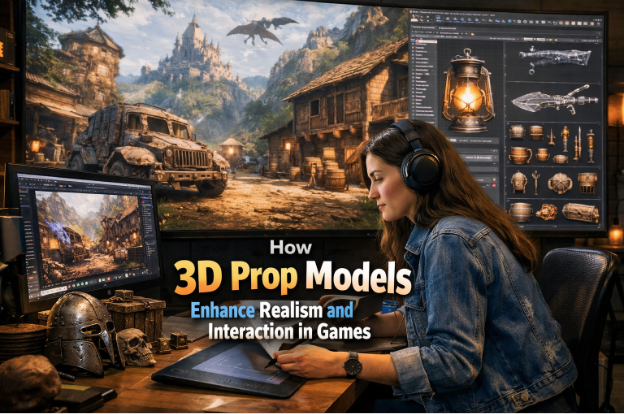

Realism and interaction are two aspects of the same coin when it comes to gameplay. The gamer may be interested in the storyline or the gameplay, but it is the interaction with the game world that helps to achieve the level of immersion. This is where 3D prop models play an important role.
Props as Interactive Touchpoints
Props are generally the most heavily interacted-with objects in a game. Weapons, doors, switches, boxes, furniture, and other objects in the game environment serve as interaction points between the player and the game world. Well-designed objects can assist the player in understanding what can be used, moved, or manipulated.
Adding Realism with Visual Details
Realism in games is more than just having high-resolution graphics—it’s about believability. Props with wear, damage, and functionality are much more believable than props that are simply plopped into the game world. Scratches on metal, chipped paint, or deformation all tell a story of history and use.
Supporting Meaningful Player Interaction
It is more satisfying to work with objects that look and behave as expected. A heavy object should look and feel heavy, a mechanical object should look like it could work, and objects that are used should provide good visual feedback.
With 3D prop models, artists can create assets that communicate visually how they can be used. Levers look as if they can be pulled, buttons look as if they can be pressed, and tools look as if they have been designed for a particular purpose.
Improving Gameplay Feedback and Readability
Props can also contain critical information about gameplay. Color changes, animations, damage states, or effects can indicate whether a prop is interactive, active, or destroyed. This is critical for player choice.
Certain visual states of existence assist the player in understanding cause-and-effect relationships. For example, a broken prop can indicate danger or opportunity, and an improved weapon can be used to indicate improvement through visual representation. A good prop assists the player in understanding this even when he is in the middle of gameplay.
Balancing Detail with Performance
While detail is required to achieve realism, functionality is still a concern. Props must be created with functionality in mind for real-time applications. Too much geometry or bad textures can cause a loss of frame rates, especially if they are to be tiled in a level.
A good prop has a good balance between being interesting to look at and being efficient. Techniques such as normal mapping, smart UV mapping, and texture atlasing allow props to be detailed without putting too much strain on the engine.
Consistency Across Game Worlds
Consistency is the secret to realism. The props must be consistent with the visual rules that are applied to them in the game. This is in terms of levels of detail, size, and material logic. Inconsistencies can be distracting to the player.
Improving Environmental Storytelling
Props are an excellent tool for storytelling. A broken chair, an abandoned weapon, or a toolbox lying around can convey what has happened in the past without a single word of dialogue being spoken.
Environmental storytelling is a very prop-dependent concept. If the props are placed thoughtfully, it allows the player to fill in the world and make their own connections.
Asset Production Scaling Effectively
In modern games, there could be thousands of props, especially in open-world environments. It might be difficult for the internal team to develop so many assets without compromising the quality.
The studios can also work together with the 3D game art outsourcing services in scaling the production. This is because the artists in the outsourcing companies can create props that are optimized and ready for interaction, as per the game standards.
Long-Term Value of High-Quality Props
High-quality props can do wonders in launch graphics. High-quality assets are easier to reuse, update, or repurpose for an expansion, sequel, or new platform. Investing in 3D prop models with a focus on realism and interaction will ensure that assets are valuable throughout the lifecycle of a game.
Conclusion
3D prop models also ensure proper interaction, feedback, and smooth gameplay. Whether it is done in-house or with the help of reliable 3D game art outsourcing companies, quality prop modeling will directly help in improving gameplay interaction. For game developers who want to develop memorable and engaging game worlds, quality prop modeling is not a choice—it’s a requirement.