

The Evolution of Design: From Flat Lines to Digital Realities
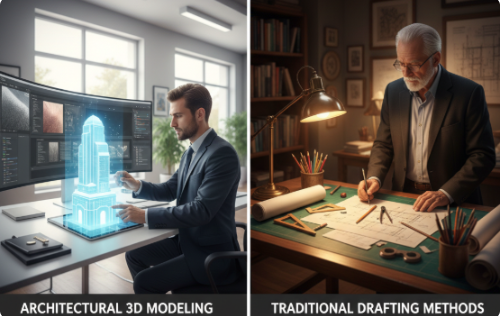
The architectural world is at a design crossroads between two design periods, which separate traditional drafting from modern architectural 3D modeling.
The industry operated for decades on 2D drafting accuracy, which began with hand-drawn blueprints and advanced to Computer-Aided Design (CAD) systems. 3D workflows now replace traditional methods, which established the base for current infrastructure design.
Architects who use professional 3D visualization services discover that 2D to 3D transitions deliver more than software updates because they change fundamental environmental comprehension methods.
1. Spatial Comprehension: Imagination vs. Experience
Traditional drafting requires a specialized skill set to interpret. An architect needs to mentally connect multiple drawings because a 2D floor plan or section shows only an abstract representation of a room volume.
Designers tend to make translation errors when they attempt to explain their designs to clients. 3D architectural modeling delivers instant spatial comprehension to viewers. The model presents a three-dimensional space that enables automatic depth, height, and perspective rendering.
A 3D visualization company can create a dollhouse view or virtual walkthrough from this model, which enables stakeholders to experience building scale as if they stood within it. The client shifts their role from trying to imagine things to experiencing everything directly.
2. Accuracy and Conflict Resolution
A floor plan update in traditional drafting creates elevation and section drawing errors, which do not show automatic updates. The manual coordination process results in frequent errors because it creates clashes, which occur whenever structural elements or plumbing lines share the same space.
Architectural 3D modeling operates as a single, unified database. In the 3D environment, window movements create view and schedule updates, which happen across all views instantaneously. 3D modeling services use clash detection software to locate physical intersections between building systems before construction begins. The coordination process within 2D drafting requires multiple elements, which make it impossible to achieve.
3. Environmental and Performance Simulation
Traditional drafting shows static building designs, which limit viewers to seeing exterior building appearances without gaining knowledge about building performance.
Architects needed to create complex calculations or physical scale models to analyze sunlight and airflow before the development of architectural 3D modeling. With architectural 3D modeling, design performance data is integrated directly into the design process.
The site coordinates enable a 3D visualization company to generate solar paths, wind speeds, and thermal load calculations for every day throughout the year.
The building orientation and window placements achieve maximum energy efficiency through data-driven design, which modern sustainable architecture requires to meet its essential standards.
4. Revisions and Project Timelines
The revision loop represents the main challenge that people face in traditional drafting. After a client meeting, 2D drawings require extensive manual updates, which take multiple days to complete.
Architects become less inclined to make significant design modifications during the late design phase because of this practice. 3D modeling thrives on iteration. The digital model’s flexibility enables designers to create multiple design options that test different design scenarios.
The design process benefits from this agile system because it decreases the total project time from initial concept to final construction.
Conclusion
Technical precision through traditional drafting methods taught us essential skills, but architectural 3D modeling improves those skills through advanced depth and data analysis, and communication capabilities.
Architectural evolution has transformed architectural design into a dynamic digital prototype that architects can manipulate.
3D visualization services help firms reduce risks while they deliver impressive results to clients through constructing architecturally beautiful yet efficient buildings.
Blueprint design now includes three-dimensional elements because flat blueprint design has not become obsolete.